Edition of Friday, 6 November 2026
Yesterday's world, explained in 3D.
Every morning, the previous day's most-followed stories become short films on a 3D globe. Each story gets the analysis its kind needs, and every claim links to its source.
14 stories today · 5 editions · every sentence cited · no account
Lenses
Each story gets the analysis its kind needs.
An election is told with its results, a person with their life, a crash with its route. Anything else gets a general film: what happened, where, and who read about it.
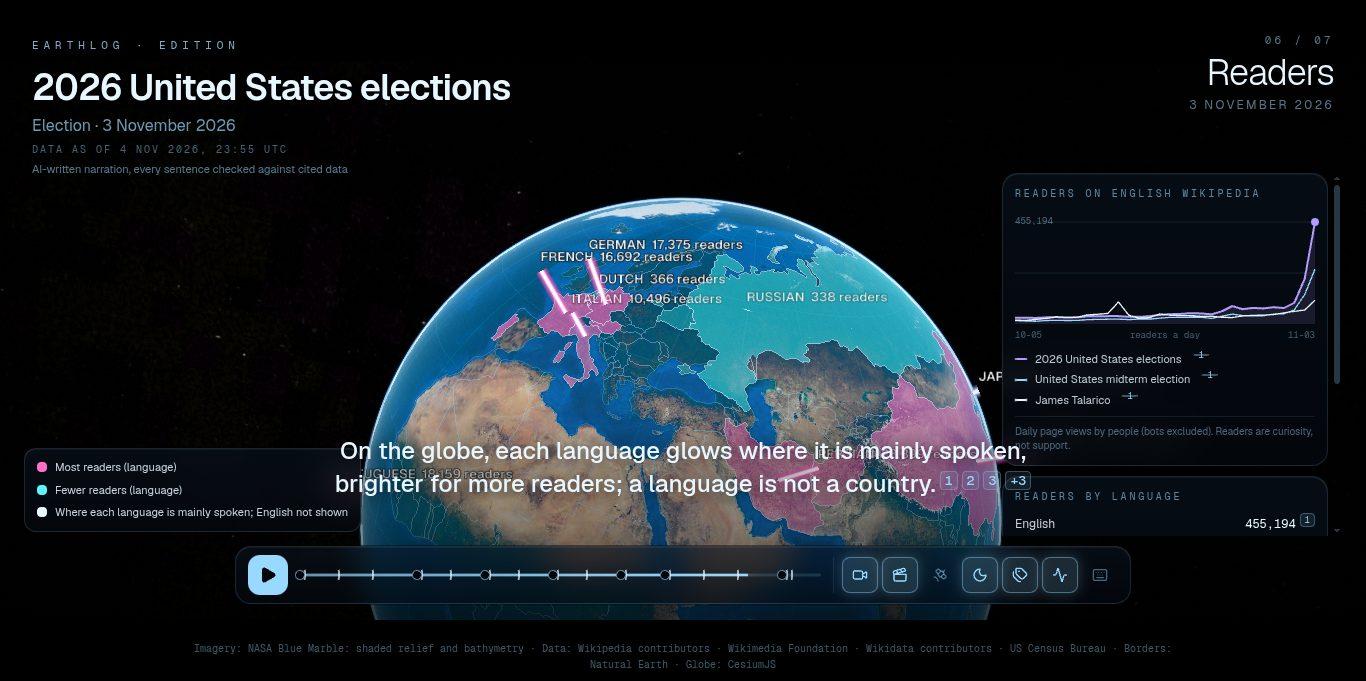
- Elections
- Results race by race; flipped seats pulse, uncalled races stay grey.
- People
- A life drawn across the globe, from birthplace to the places that shaped it.
- Companies and tech
- Headquarters, what is on record, revenue over time.
- The economy
- The institution, its country in numbers, its region compared.
- Sports
- The venue, the teams' home cities, the result.
- Culture
- The credits, the filming locations, where the cast was born.
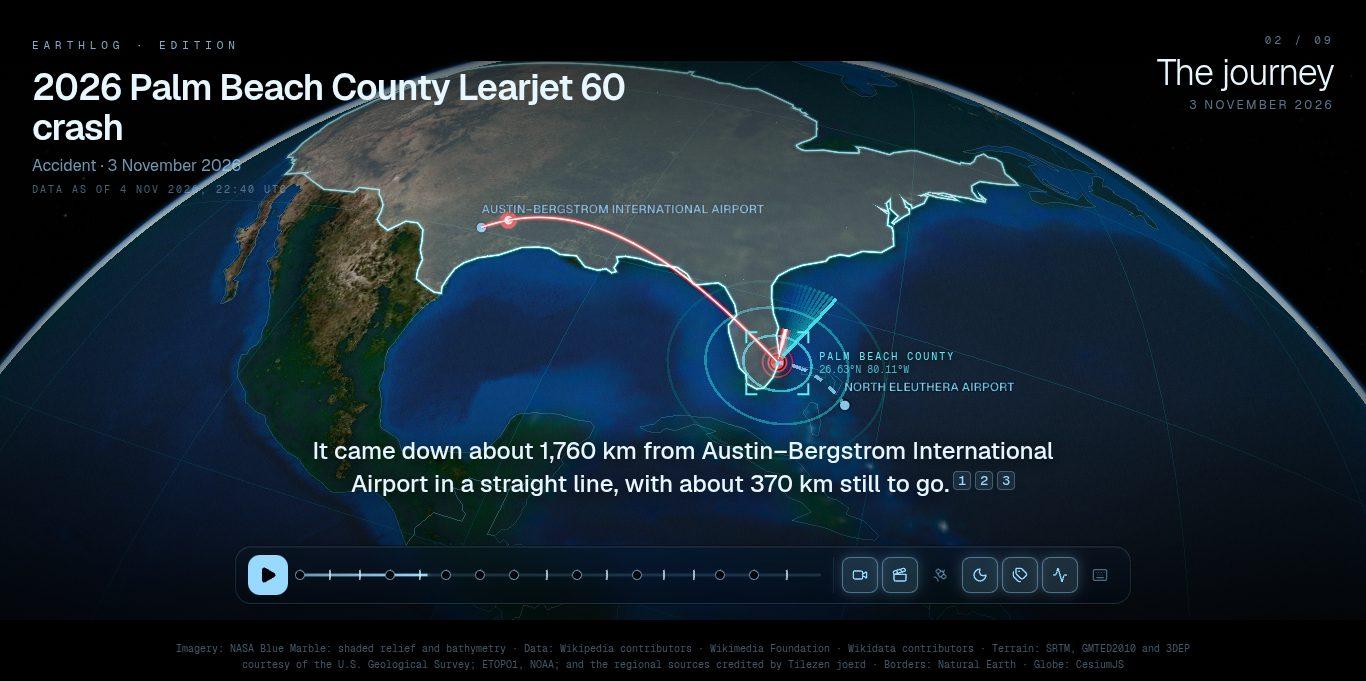
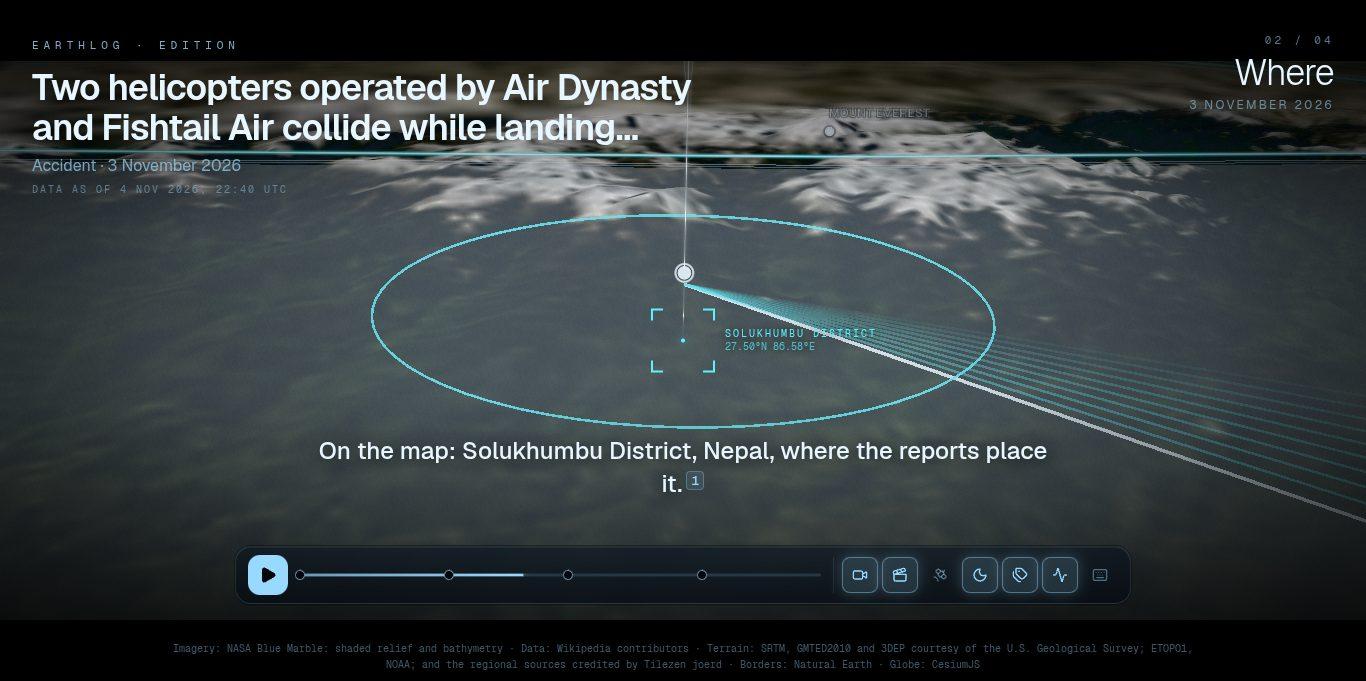
- Accidents
- The route flown and the leg never reached, the site on real terrain.
- Earthquakes
- USGS shaking spreading outward, the fault, people exposed.
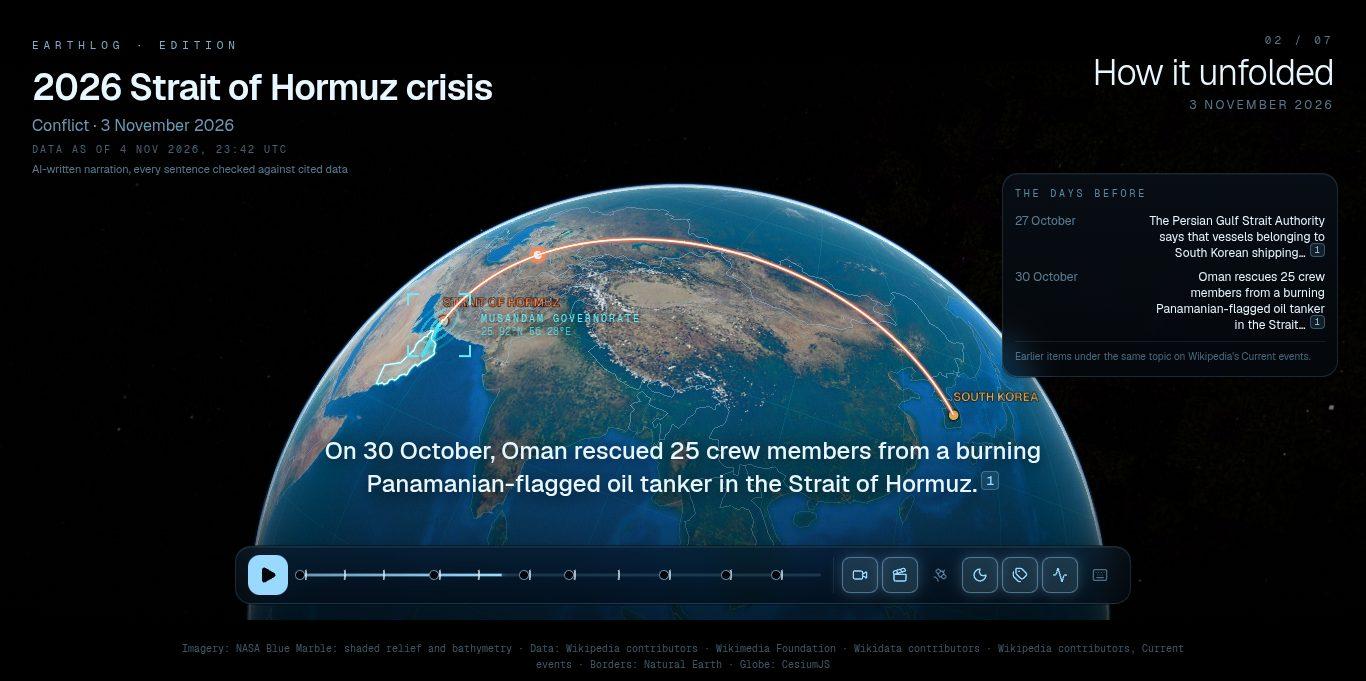
- Conflicts
- The week day by day; figures as the sources record them.
- Science and space
- The launch site, the mission, the landing.
Why you can trust it
Proof on every line.
Every claim is cited
Each sentence and number links to the evidence it rests on. A validator rejects anything else, whoever wrote it.
AI is optional and checked
A template writes every film. Claude may rewrite captions once, offline; each chapter is checked in code or keeps the template.
Open data, honestly shown
Wikipedia, Wikidata, World Bank, USGS, NASA. Estimates say so, and every film says when its data was read.
Free for everyone
No account, no ads, no tracking, no backend. MIT-licensed and built to be forked.
How it works
Made overnight, free to watch.
The work happens once a night in a GitHub Action. Visitors download static files: no AI calls, no keys, no backend.
pnpm edition 2026-11-04   # find and rank the stories
pnpm stories 2026-11-04   # one film per story
pnpm direct 2026-11-04 --ai   # optional narration
pnpm validate:scenes # every sentence cited- 1Find the storiesWhat the news reported and what the world read on Wikipedia, ranked by attention and balanced across continents.
- 2Choose the lensWikidata says what each story is (an election, a person, a crash, a quake) and the matching lens gathers its data.
- 3Make the filmChapters, camera moves, maps, charts and captions, every sentence cited, then validated.
- 4Publish by morningA GitHub Action runs it overnight and commits the edition. Visitors download static pages: nothing runs per visit.
Archive
Every edition is kept.
Editions follow the news for three days, then freeze. Day by day, the archive becomes a record of the planet.
- Friday 6 November14 stories · Michael Locke (stuntman) · Kimmarie Johnson · Jay Rockefeller
- Thursday 5 November17 stories · Jesús de Miguel · Russell Brand · Scott Colom
- Wednesday 4 November12 stories · Jesús de Miguel · Gina Hinojosa · Abdul El-Sayed
- Tuesday 3 November15 stories · Jesús de Miguel · 2026 United States elections · 2026 Palm Beach County Learjet 60 crash
- Monday 2 November17 stories · Susan Saint James · Ciara Mageean · Learjet 60
Classics: landmark events, replayed minute by minute
FAQ
Questions, answered.
Something else? Open an issue on GitHub.
What is Earthlog?
A daily edition of yesterday's most-followed stories, each told as a short film on a 3D globe: an election state by state, a life drawn across the map, a flight's route to the crash site. Every sentence links to its source.
Where do the stories come from?
Two public signals: what the news reported (Wikipedia's Current events, which cites news outlets) and what the world read (Wikipedia's most-read articles). Stories are ranked by attention and balanced across continents and kinds of news.
Is any of it written by AI?
Every film is first written by templates from the data. Claude may then rewrite the captions once, offline, and each chapter is checked in code: every number must appear in the cited evidence, or the template stays. Films with AI narration say so on screen. Visitors never trigger an AI call.
How fresh is the data?
A new edition is built every night. For three days an edition follows the news (results and reports still fill in), then it freezes. Every film shows when its data was read.
Do I need an account? Am I tracked?
No account, no ads, no analytics. The site is static files; Earthlog records nothing about your visit.
Can I share a story or download a video?
Yes. The link button copies a link to the exact moment you are watching. The film button exports the story as an MP4, landscape or vertical, with its captions, stats and sources.
Does it work on my phone?
Yes, on any recent phone or computer with WebGL. The globe is heavy, so the first load takes a few seconds on a slow connection.
Can I use the code or add a kind of story?
Earthlog is MIT-licensed. Each kind of story is a lens: one file and a few tests. The contributing guide explains how to add one.
Open source. Add a lens.
Earthlog is MIT-licensed. Fork it, run it for your own region, or teach it a new kind of story: a lens is one file and a few tests.